On December 10th, Canton Network will undergo a major version upgrade.
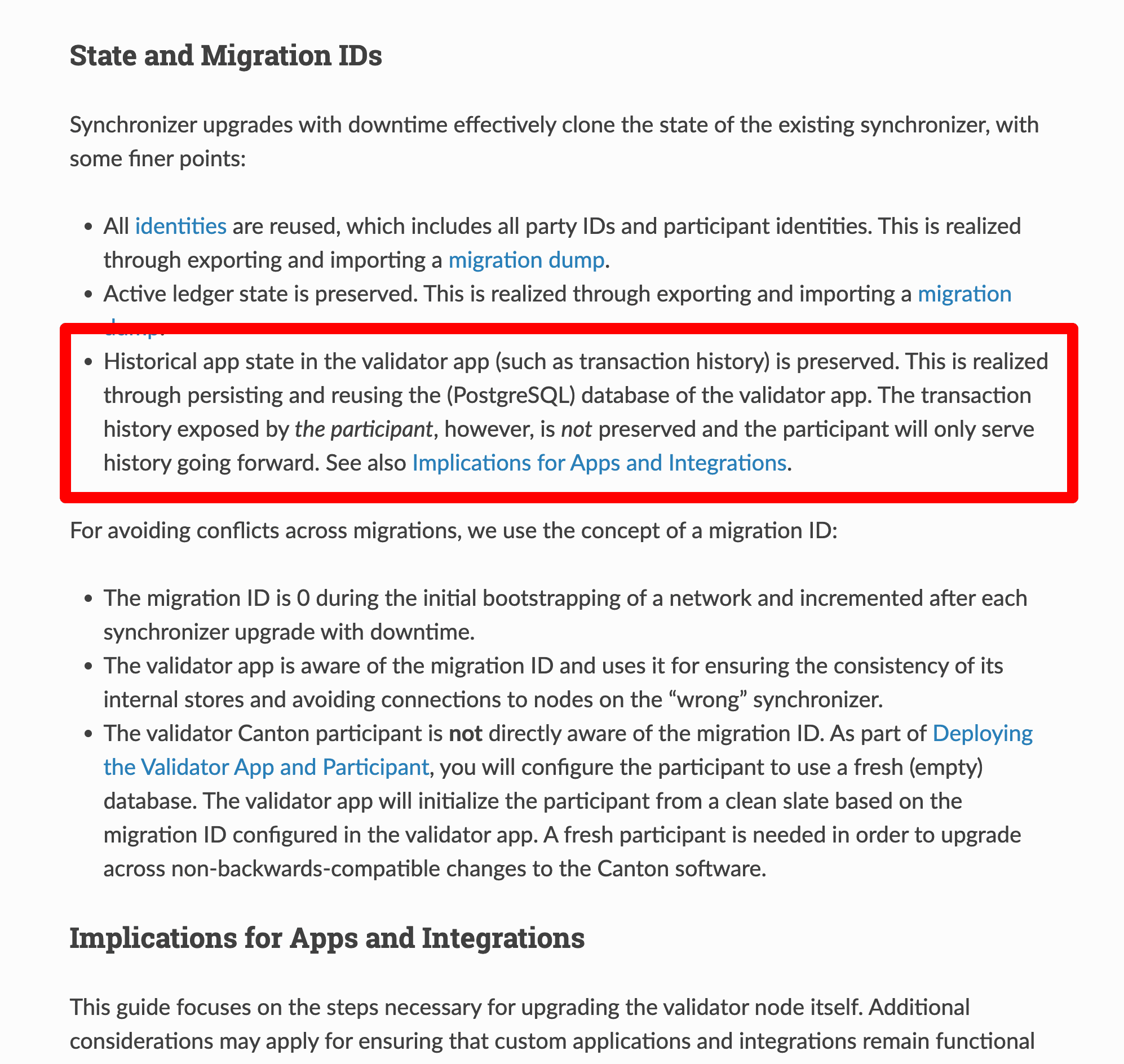
Along with this upgrade is a change that many people are underestimating: your node’s transaction history will be deleted. In practice, this means your node will no longer retain the majority of pre-fork transaction history. Calls to the Ledger API asking for activity before the upgrade will come back empty, or with very limited results.
Public Canton Coin (CC) transactions will still be retrievable through the Scan API, but any private transactions e.g. CBTC movements, private contracts, or any transaction involving private assets or private details, will no longer be accessible via the Ledger API.
If you do not take action before December 10th, your node history will be lost.
Which transactions are affected?
When the upgrade happens, your Canton node keeps the current state it needs to continue operating. But the detailed transaction history leading up to that state is removed from your node’s participant storage. Any call to the Ledger API attempting to pull “what happened before the fork” will return only a handful of transactions. Public CC activity is indexed externally and retrievable via the Scan API.
Transaction data related to the following, however, will be deleted:
CBTC
CUSD
USDC
Cantara
Private contracts
Private data attached to transactions
Transactions involving any tokens that aren’t CC
In other words: anything that isn’t public Canton Coin and lives behind Canton’s privacy model will vanish from your node’s historical data. There is no equivalent public block explorer to retrieve this. All history, all records of private transactions will be permanently deleted.
What does this mean for Canton validators?
In January, validators and operators on Canton Network will be preparing their financial records for 2025 (and prior years) for:
Audit
Taxes
Reporting
Accounting
Regulatory and Legal Inquiries
Internal Investigation and Analysis
Each scenario hinges on having a complete historical record for 2025 and earlier. After the hard fork, that record will have permanent gaps unless you have a backup saved in advance.
For Canton validators, not saving this historical data is an operational and compliance risk. This is entirely preventable, but only before the upgrade.
How to back up your node history
To make this easy, Noves has shipped a free, self-serve Node Backup / Export module within the Noves Data App.
What it does:
Allows you to privately connect your node via Party ID login
Generates a backup of your node history (public and private)
Writes it to any S3 bucket you specify
Saves an archive for you to access or query later
To save a backup:
Install the Noves Data App for Canton (if you haven’t already)
Request access to the backup module: cc.noves.fi/backup
Run the backup before December 10th
If you do nothing
Any 2025 (and earlier) requests for full transaction history from auditors, regulators, tax advisors, or internal teams, will run into permanent gaps. You will not be able to reconstruct the missing data from your node once the hard fork has happened.
Take action
Save a backup of your node’s pre-fork history now:
Support
If your team has questions about the backup, data handling, how to install the Data App, or anything else, we’re happy to walk you through it and make sure you’re covered before December 10th.
Please message us on Slack:
@Ben Roy, CEO
@Juan Costa, COO
@Jesse Jones, Growth
@Christian Reza, Marketing
Or you may also send us an email:
support@noves.fi